
Frequently Asked Questions
You can buy as many trees as you like!
Whether it is a feature tree, a single tree for a special occasion, commemoration or celebration or to fill a forest full, we can supply singly or in quantity.
Just get in touch and we can talk through your requirements.
Email: info@beechgrovetrees.com
Mobile : 07584 042670
Message us on Facebook
Yes, we are happy to advise and assist with whatever you need, including at the planning stage. Choosing the right tree(s) for the right place(s) as well as to fit with your requirements and the conditions you are working with is important.
We can help ‘in house’ or can bring in specialists to help with e.g. grant applications. We can also consult full time, professional Foresters as well as Forestry, Woodland and Management Companies on your behalf. We are happy to guide you through Environment Impact Assessments for large scale schemes.
Take a look at our ‘About Us‘ page to learn a bit more about our background and credentials.
Email: info@beechgrovetrees.com
Mobile : 07584 042670
Message us on Facebook
Feel free to pop over and pick your plants up!
Alternatively, we can package up and deliver locally or nationwide, at cost.
Please be prepared to plant your trees soon after they arrive.
Get in touch and we can have a chat about what will work out best.
Email: info@beechgrovetrees.com
Mobile : 07584 042670
Message us on Facebook
We mainly focus on the native hardwoods – oak, birch, rowan, alder, as a few examples – the trees that would make up a natural wood in this part of the country. We’re also looking at offering Scots Pine and some of the more widely used forestry and landscape trees such as beech and sycamore.
We can source trees for you that we may not have ‘in house’.
Please see our trees page for the full list, or give us a call to see what we can provide.
Email: info@beechgrovetrees.com
Mobile : 07584 042670
Message us on Facebook
Depending on the project, priorities and our diaries, we could help out with tree planting ourselves!
Alternatively, we could recommend appropriately trained tree planters. Depending on the scale of the project, that could involve organised tree planting teams over a longer period of time.
Get in touch and let’s see what would be the best plan:
Email: info@beechgrovetrees.com
Mobile : 07584 042670
Message us on Facebook
We’ve written a blog to give you some handy tips on planting your trees.
In brief, you want to plant out your trees in the months when trees are dormant.
We have written more detailed information in our ‘What is the Best Time to Plant my Trees‘ blog.
If you don’t have the time for finding out more, in a nut shell… seed provenance means ‘where the seed came from’!
We’ve written a blog to tell you all about seed provenance, have a wee read of it here.
Once you have your trees, the last thing you want is for them to be nibbled/ eaten/ devoured by the locals!
We offer all kinds of guards and stakes to keep your young trees in tip top condition. We would direct you to local fencing contractors, with whom we have good working relations, as they are best placed to discuss your fencing requirements,
For a little bit more info, we wrote a little bit about the pros and cons of fencing in our blog offering Hints and Tips of Planting Trees.
Do get in touch if you’d like some advice or pointers with regards any fencing, stakes and guards queries. No such thing as a silly question!
Email: info@beechgrovetrees.com
Mobile : 07584 042670
Message us on Facebook
Yes!
Your young trees will be hardened off prior to your purchase (brought outside to feel the wind in their leaves etc). They will be acclimatised and accustomed to the local climate.
Once they have arrived at their new home, you can keep them wrapped for a few days, but once unwrapped, they need to go straight into the ground.
Have a look at the page of Our Trees that are available.
Yes, we offer a number of the more common species – beech, hawthorn, cotoneaster as examples. All are chosen because of their individual benefits.
We’re happy to discuss any further questions – just get in touch!
Email: info@beechgrovetrees.com
Mobile : 07584 042670
Message us on Facebook
And check out Our Trees page to see what we currently have to offer.
So many benefits! See our blog on Native Broadleaf Trees to be inspired!
Email: info@beechgrovetrees.com
Mobile : 07584 042670
Message us on Facebook
What is the best situation for my new saplings? Like any new plant, trees and hedging plants need a balance of nutrients and water, protection from being grazed or browsed and protection from stems being damaged. As they are relatively small, they are also sensitive to competition from surrounding vegetation. Some pre-planting management can make life easier.
In a forestry situation, planting plots are usually either sprayed with herbicide, and/or small mounds created into which the tree is planted. This helps establish the plant and makes them easier to find for subsequent weeding. Protection from grazing/browsing animals can be provided by suitable fencing, or if smaller numbers of trees are concerned, by tree tubes. Tree tubes have the advantage of also providing a better growing environment for young trees (which is especially important with late spring planting when drought may occur). On exposed sites however, once trees pop out of the top of a tube, they can get damaged when they are blown against the top edge of the tube.
With our experience of the local area, we are well placed to help advise on a specific plan for establishing trees and their subsequent maintenance, so just get in touch.
Hedges are used by wildlife for shelter, feed, nesting and hibernating. A mixed hedge with some flowering/fruiting species (eg hawthorn, rowan, bird cherry, holly and hazel) and some species which hold their leaves (eg beech, holly and oak) will provide a range of benefits throughout the year.
There are a few species which are found in hedges which, in some circumstances, can cause issues. Blackthorn tends to sucker out into fields, so if the hedge is going to be through agricultural fields, blackthorn may not be ideal, although could be used in corners or where any it’s spreading habit is not a problem. Elder has a tendency to cast heavy shade, and so shades out other species. It then loses it’s leaves early in the autumn, creating increasingly large gaps in the hedge.
Over time, hedges will naturally have other species added, like bramble and rose, through bird droppings.
Any hedge will break up the wind and provide shelter (both down and upwind). Most hedges are predominantly made up of hawthorn, with a handful of other species, such as holly, hazel, rowan adding diversity. Both oak and beech can be kept cut to provide a hedge which will retain much of it’s leaf during the winter, so offering more shelter and privacy during the winter.
Most hedges will require some protection from grazing and browsing until they fully establish. This can be provided with spiral tree guard, shrub shelters or by using vole guards combined with rabbit netting.
Coastal planting is perhaps the most difficult to deliver, as the air is usually heavily salt laden, and this can significantly affect many trees.
The best option is to look around the area the trees are to be planted in, to see which species are just surviving and those which are growing well. Oak, holly, hawthorn, rowan, willow, Scots pine and birch are likely to make up most coastal planting. Where there is a bit more shelter, such as cleuchs and gills, other species like bird cherry might be included.
Most upland soils are generally fairly acid in nature, and more exposed. Some areas, such as scree areas and deep peat should not be planted. This can limit the range of trees which would do well, and mean that some options, such as tall tree tubes, may not be advisable.
Hardy species such as sessile oak, birch, rowan and in more sheltered areas, holly, hawthorn and bird cherry would provide a natural looking diverse woodland. If you send us some photographs of the area where you are looking to establish the trees, will will always try to find a mix of species which would grow well and meet the requirements of your planting scheme.
As with any project, it is best to look to plant trees which would grow well in the ground conditions and exposure of the site. For example, a heavy clay soil would usefully grow oak or beech, where as a dry, exposed site would favour birch and possibly pine.
In order to help find the best tree for your project, if you can send up some photos of the areas you are looking to plant, and some of the natural flowers that are growing there, we can use aerial photos combined with our extensive knowledge to help develop a viable planting scheme with you that would meet your community project objectives.
Where possible, we will try and collect seed locally from trees which are good examples of their species. We will try and collect from a range of individual trees, so as to get some genetic diversity in the collected seed. We keep records of where seed is collected from, so we will be able to locate the seed source. Trees do not always produce a good crop of viable seed each year.
Also, the practicalities of collecting the large volumes of seed required mean that we will buy in seed from a national seed supplier. This might also be required for seeds which have a long dormancy period, or where it is difficult to break the seed dormancy cycle. Where we do this, we will always seek to source seed from as near at hand as possible. Sometimes it is possible to get seed collected from Dumfries and Galloway, but at other times, we need to work with seed from further afield.
Didn't find the answer to your question?
Tree & Hedging Tips

Bee leaf in trees
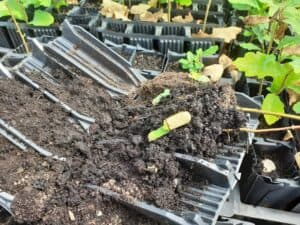
I was just moving a couple of locally-collected crab apple plants between growing cells and found these odd capsules made of leafy material. I took one apart and found a round ball of
What is the Best Time of Year to Plant my Trees or Hedging?
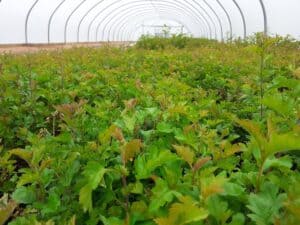
Generally we recommend planting your trees in the Autumn, Winter and the early part of Spring. With cell grown trees, you have more latitude than bare rooted trees. A bare rooted tree needs
What is Seed Provenance?
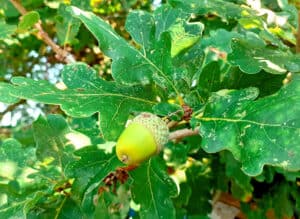
“Seed provenance” – a lovely phrase that rolls off the tongue effortlessly, yet makes you sound knowledgeable! What does ‘seed provenance’ mean? In a nut shell… seed provenance is ‘where the seed
Tree and Hedging Planting Tips
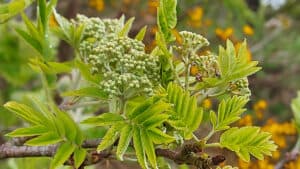
Preparation, preparation, preparation! Want to know our handy hints and tips on planting trees and hedging? Here are a few to give your young trees the best start in their new environment: Fit
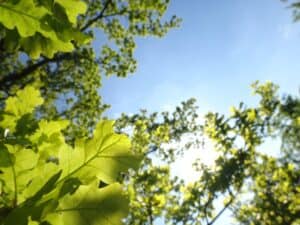
What are the Benefits of Using Native Broadleaf Trees?
There are so many benefits to choosing native broadleaf (deciduous) trees! Herein lies an inexhaustive list – do let us know if you have other reasons to buy native broadleaves! The right tree
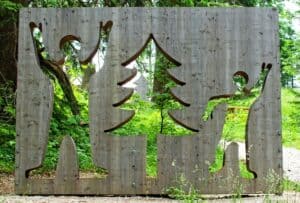
What trees will work best for our community projects?
As with any project, it is best to look to plant trees which would grow well in the ground conditions and exposure of the site. For example, a heavy clay soil would usefully
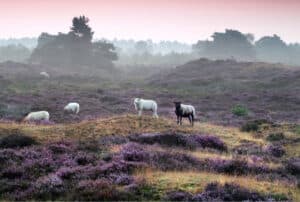
What trees are best for an upland farm planting?
Most upland soils are generally fairly acid in nature, and more exposed. Some areas, such as scree areas and deep peat should not be planted. This can limit the range of trees which
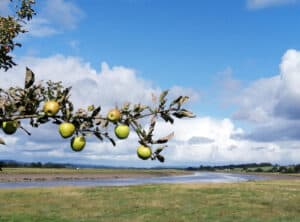
Which trees are best for planting in a coastal setting?
Coastal planting is perhaps the most difficult to deliver, as the air is usually heavily salt laden, and this can significantly affect many trees. The best option is to look around the area